

Outlook
Part of How to read the sponsorship rates outlook for your next rate review
How AI can help review sponsorship rates
Use AI-assisted checks to review sponsorship rates, test comparable data and campaign assumptions, and record UK disclosure and data-handling decisions.
What to take away
AI-assisted planning for sponsorship rates is a workflow, not necessarily a dedicated pricing tool: use comparable-deal data, audience analytics and general AI tools to organise a quote and test its assumptions. The output is a prompt for review, not proof of a market rate.
- AI changes the speed and consistency of a quote, not the underlying value of the audience.
- No single tool output is a UK rate benchmark; build each quote from relevant comparables, reach, format and exclusivity.
- Disclosure and data rules still apply to the deal itself, whatever produced the number.
- Set review triggers now, because tool pricing and model behaviour change faster than your rate card.
Where AI-assisted tools fit into the quoting process
AI-assisted tools can support a sponsorship quote in three places: finding comparable data, forecasting engagement on a proposed campaign, or drafting commercial terms. These are different tasks, and each carries a different risk profile.
Three AI Contact Points, Ranked by Risk
Contact point
- Benchmarking
- Checks comparable rates
- Forecasting
- Models campaign engagement
- Drafting terms
- Writes commercial clauses
What it does
- Benchmarking
- Lowest risk
- Forecasting
- Hard to verify
- Drafting terms
- Highest risk
Risk level
- Benchmarking
- Forecasting
- Drafting terms
Audit checklist before you publish
- Find comparables. Influencity, Upfluence and HypeAuditor can help surface creator and audience data, but they are influencer databases, not tools that independently set a verified UK sponsorship rate. Check the territory, format and source by hand; do not treat an output as a definitive rate card.
- Forecast engagement. Google Analytics 4 and Meta Business Suite are analytics tools, not AI pricing tools. Use their data to inform a campaign forecast and test assumptions against past campaign results; platform data may not capture every factor.
- Draft terms. ChatGPT or Claude can help organise a checklist of commercial terms. Treat the result as a draft, not legal advice, and check it against the contract you have already signed.
- Log the contact point. Record which tool produced each number and the inputs it used, so a query about a quoted price can be traced back to its source.
- Check the rationale. Ask the tool to flag whether your quote accounts for reach, format, exclusivity, category fit and negotiation history. Use this as a completeness check, then justify any changes yourself; a tool cannot establish that the rate is right.
- Draft a deal-file note. You can ask a tool to structure a note from approved inputs, then verify it yourself. Do not include audience-level personal data or confidential deal information unless your organisation has approved that use.
Tool output still needs to be read in the wider market context. The overview of sponsorship rates trends and outlook for England in 2027 gives that broader context; it is not a benchmark for an individual deal.
Worked example: adjusting a quoted rate
A tool output is a starting figure, not a final quote. Suppose a tool returns £600 for a single sponsored post. Compare it with three comparables for the same follower band and engagement rate. If your verified set sits above £600, investigate whether the gap is justified before adjusting; if it sits below, do the same in reverse. Record the gap and the sources.
Adjusting a quoted rate
Without AI pricing tools
- Benchmarking
- Manual search of past deals, often a day of work
- Forecasting
- Simple average of recent campaign results
- Rate card drafting
- Written from experience and negotiation notes
- Disclosure checks
- Manual review against platform rules
- Review cycle
- Annual, tied to planning
With AI pricing tools
- Benchmarking
- Suggested comparables in minutes, quality varies
- Forecasting
- Modelled engagement, sensitive to input data
- Rate card drafting
- Drafted from templates, needs legal review
- Disclosure checks
- Flagged automatically, still needs a human sign-off
- Review cycle
- Continuous, tied to model updates
The shift is toward faster drafts and more frequent review. The accountability does not move.
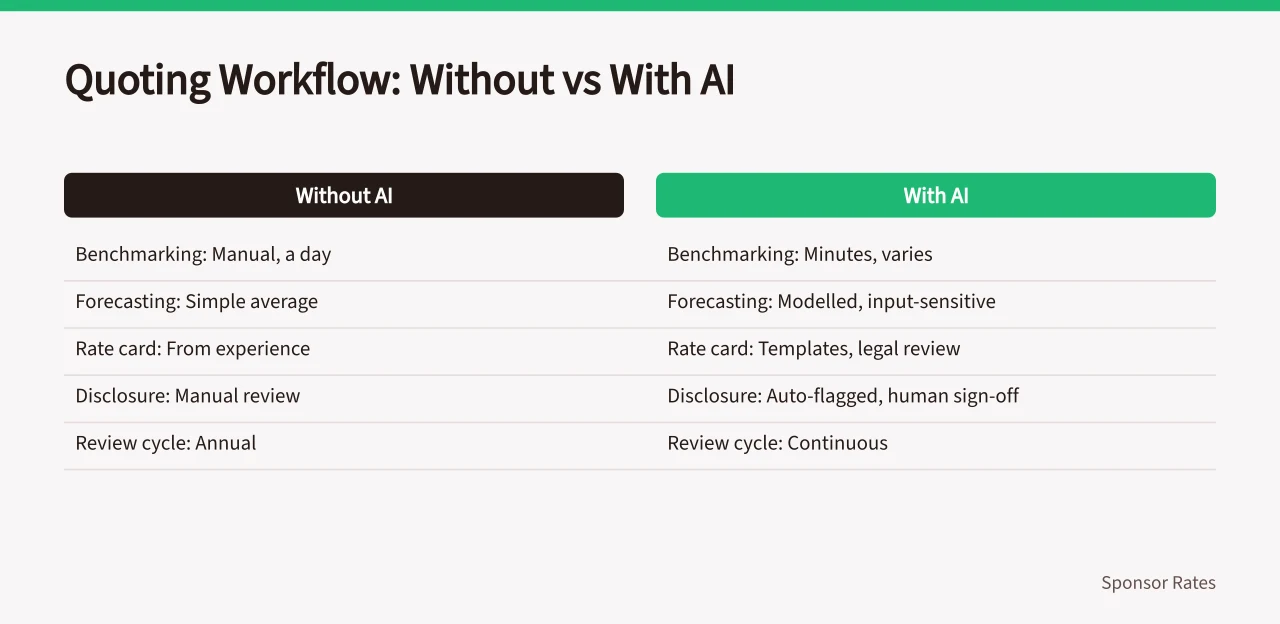
Treat the table as a working document. Mark which stage you have already automated and which still depends on a person, then name an owner for each row.
Governance and review triggers
For each tool, name a human owner and record its intended use, approved inputs, output checks and escalation route. Review the tool's terms and settings before using it with audience data or confidential deal information.
Data and disclosure duties
For UK sponsored content, the Advertising Standards Authority (ASA) administers the CAP Code, which includes rules on making marketing communications recognisable as advertising. For audience data processed by these tools, follow the UK GDPR and the Data Protection Act 2018, and check the Information Commissioner's Office (ICO) guidance. The Digital Economy Act 2017 is not the advertising-disclosure code or the general data-protection regime, so it is not a substitute for those rules.
For UK-only work, keep the review focused on the ASA and CAP Code; FTC guidance matters only where US audiences are involved.
These rules do not tell you what to charge. Keep a dated record of which tool produced each figure and the evidence behind it, so a later query can be answered without guesswork.
When to re-run the numbers
Set triggers rather than relying only on a calendar. Re-run your AI-assisted benchmark when a platform changes its measurement, when a tool updates its model, when your own win rate crosses a threshold you set, or when a new category of advertiser enters your pipeline.
Note who approved the last rate and what evidence sat behind it. A trigger only helps if you can see what changed.
For a structured way to test what happens if those triggers fire badly, work through sponsorship rates risk scenarios in England before you commit to a published rate.
Common questions about AI and sponsorship rates
Do AI pricing tools change the rate I should quote?
The rate still depends on reach, format, exclusivity and verified comparables. A tool can speed up the draft, but it does not set the price.
Is AI pricing allowed under UK advertising rules?
There is no blanket prohibition on using AI to assist with pricing. For UK sponsored content, the ASA and CAP Code govern disclosure; audience data must be handled under the UK GDPR and relevant data-protection law. The campaign remains responsible for disclosure, data handling and the accuracy of any claim. The tool is not the regulated party. You are.
How often should I re-check tool output?
Quarterly is a reasonable default for most creators, with an immediate re-run after any platform measurement change or model update. If your win rate shifts sharply, check sooner.