Outlook
City rate cards for Bristol, Leeds and Glasgow, matching price to local brand demand
Influencer rates in Bristol, Leeds and Glasgow: build city rate cards tied to local agency mix and sector demand, with bands you can quote today.
What to take away
- Quote a city card, not a national average.
- Bristol pays for purpose-led work, Leeds for agency volume, Glasgow for cultural and public campaigns.
- Define Low, Mid and High once, then apply the sector and city modifiers.
- All £ ranges here are indicative author estimates, not published city cards.
- Size the advertiser base from official data before you name a band.
How to build a city rate card for Bristol, Leeds and Glasgow
A city rate card is a grid: content format down one side, price band across the top, with a note on which local buyers pay which band. Build one per city, then keep the three in the same format so you can compare and defend your quote.
Build a city rate card
- List formats you sell
- Pull local advertiser count
- Note dominant agency types
- Assign base band per format
- Add sector modifier
- Add agency premium
- Test against live brief
Start with the advertiser base. The Business activity, size and location statistics show how many businesses operate in each city and region. That tells you whether you are pitching to a handful of agencies or a deep pool of direct brands. Use that to set the floor price, not the ceiling.
Band thresholds used here are follower tiers: Low is 5,000 to 25,000 followers, Mid is 25,000 to 100,000, and High is 100,000 to 250,000. All £ ranges in this article are the author's indicative estimates for typical UK regional deals, not published Bristol, Leeds or Glasgow rate cards.
How to build a city rate card
- List the formats you sellshort-form video, static post, story set, long-form review, event appearance.
- Pull the local advertiser count for the city and its surrounding region.
- Note the dominant agency typescreative, media, PR or in-house brand teams.
- Assign a base band to each format using local quotes, not national rate cards.
- Add a sector modifier for regulated or high-budget categories.
- Add an agency premium where a media agency is buying on behalf of a brand.
- Test the card against one live brief before you publish it.
That process is the same whether you are quoting a rate card or a bespoke deal. The difference sits in how much of the card you show the buyer.
Keep the card in a spreadsheet with a column headed Source, recording where each price came from: a competitor quote, a past deal or a published benchmark. When someone challenges your rate, you point to the Source column, not to your follower count.
Bristol rate bands and the local agency and creative mix
Bristol rate bands sit in the middle of the three cities. The city has a dense independent creator scene and a cluster of sustainability and ethical brands, which pushes green and purpose-led campaigns toward the upper end of the mid band.
Bristol formats and buyers
Format
- Short-form video
- Mid
- Static post
- Low to mid
- Story set
- Low to mid
- Long-form review
- Mid
- Event appearance
- Mid to high
Bristol band
- Short-form video
- Independent brand
- Static post
- Local retail
- Story set
- Direct brand
- Long-form review
- Sustainability brand
- Event appearance
- Agency or festival
Typical buyer
- Short-form video
- Static post
- Story set
- Long-form review
- Event appearance
Bristol agency mix leans creative and independent. Taxi Studio and Mr B & Friends are among the brand agencies based in the city, and Aardman Animations gives Bristol a global animation buyer. In-house teams at food and sustainability brands are common, and there are fewer media agencies than in Leeds.
That means more direct brand conversations and fewer intermediated ones.
Bristol rate bands
| Format | Bristol band | Typical buyer |
|---|---|---|
| Short-form video | Mid, £600 to £1,200 | Independent brand, creative agency |
| Static post | Low to mid, £250 to £700 | Local retail, hospitality |
| Story set | Low to mid, £200 to £550 | Direct brand |
| Long-form review | Mid, £700 to £1,400 | Sustainability brand |
| Event appearance | Mid to high, £800 to £2,000 | Agency or festival |
Figures: author's indicative estimates.
Worked example for Bristol: a creator with 40,000 followers quotes a short-form video at the Mid base of £600. A sustainability brand asks for three months of paid usage and category exclusivity in food and drink.
The sector modifier adds 15 per cent, taking the base to £690, and the usage and exclusivity line adds £350, so the quote is £1,040.
Sector demand in Bristol clusters around sustainability, food and drink, tourism and culture. The Leisure and tourism statistics show how much of the local audience engages with events and attractions, which supports higher event-appearance pricing.
Green and ethical sponsorship pricing rewards creators who can evidence audience fit. If your audience overlaps with a brand's sustainability claims, you can hold the upper band. If not, you are competing on reach alone and the band drops.
Bristol buyers often ask for usage rights and exclusivity. Price those separately rather than folding them into the base band. That is where benchmark research changes the number you quote, because rights and exclusivity are priced against comparable deals, not against reach.
Leeds influencer rates and Yorkshire sector demand
Leeds influencer rates are shaped by the city's growing digital and marketing agency cluster. Agencies here buy on behalf of Yorkshire brands, so you are often quoting to a planner rather than a founder, and the process is more structured.
Leeds agency mix is media and digital heavy, with Robot Food among the city's brand agencies. Expect performance teams and a strong PR presence, alongside in-house teams at Asda, Jet2 and First Direct, plus professional services brands. Buyers work to campaign budgets and want a rate card they can slot into a plan.
Leeds rate bands run slightly below Bristol for equivalent reach because the agency buyer negotiates harder and bundles formats. The trade-off is volume: agency work is repeatable, so a lower band can still produce a higher annual total. A Leeds short-form video in the Low to Mid band typically quotes £450 to £950.
Sector demand in Leeds centres on retail, financial services, professional services and sport. Regulated sectors carry compliance costs, and those costs sit in the quote. Financial promotions must follow FCA rules, and any paid partnership must be clearly labelled under ASA and CMA guidance.
When you quote Leeds agencies, separate production from distribution. Agencies expect to see what they are paying for: concept, shoot, edit and posting are different lines. That structure also makes it easier to apply sponsorship rates pricing models without hiding costs.
- Base band set from local Leeds quotes
- Buyer type confirmeddirect brand, creative agency or media agency
- Usage and exclusivity priced separately
- Compliance cost included for regulated sectors
- Repeat-campaign discount defined
Glasgow rates, Scottish agencies and public-sector budgets
Glasgow creator rates reflect a strong creative and music scene plus brands that target Scottish audiences at separate regional rates. Scottish agencies and public-sector bodies often buy Scottish-only campaigns, which supports distinct Glasgow rate bands.
Glasgow agency mix combines Scottish creative and media agencies such as The Union with public-sector marketing teams, and broadcasters BBC Scotland and STV sit in the city. Culture, tourism, education and public health campaigns appear alongside consumer brand work, and public budgets tend to be campaign-based rather than annual retainers.
Glasgow rate bands sit close to Leeds at the base and can exceed both English cities for event and cultural work. Music, festival and cultural appearances command a premium because the audience is concentrated and the appearance is hard to substitute.
A Glasgow short-form video in the Low to Mid band typically quotes £450 to £1,000, and event appearances in the Mid to High band run from £700 to £1,800.
Sector demand in Glasgow spans culture, tourism, music, education and public health. The same leisure and tourism statistics behind Bristol pricing show the scale of cultural participation, which underpins public and tourism budgets. Those buyers often need invoicing through a registered business, so keep your HMRC and Companies House details ready.
Public-sector procurement runs through Public Contracts Scotland, and low-value briefs often go to Quick Quotes. Expect purchase orders, fixed deliverables, sign-off stages and typical payment terms of 30 days from a valid invoice. Price the admin time into the band rather than absorbing it.
Scottish brands often want Scottish-only audience delivery. If you can evidence that, you can hold a regional premium. That is a demand signals explained question: show the buyer the evidence, and the premium holds.
Matching each price band to local brand demand
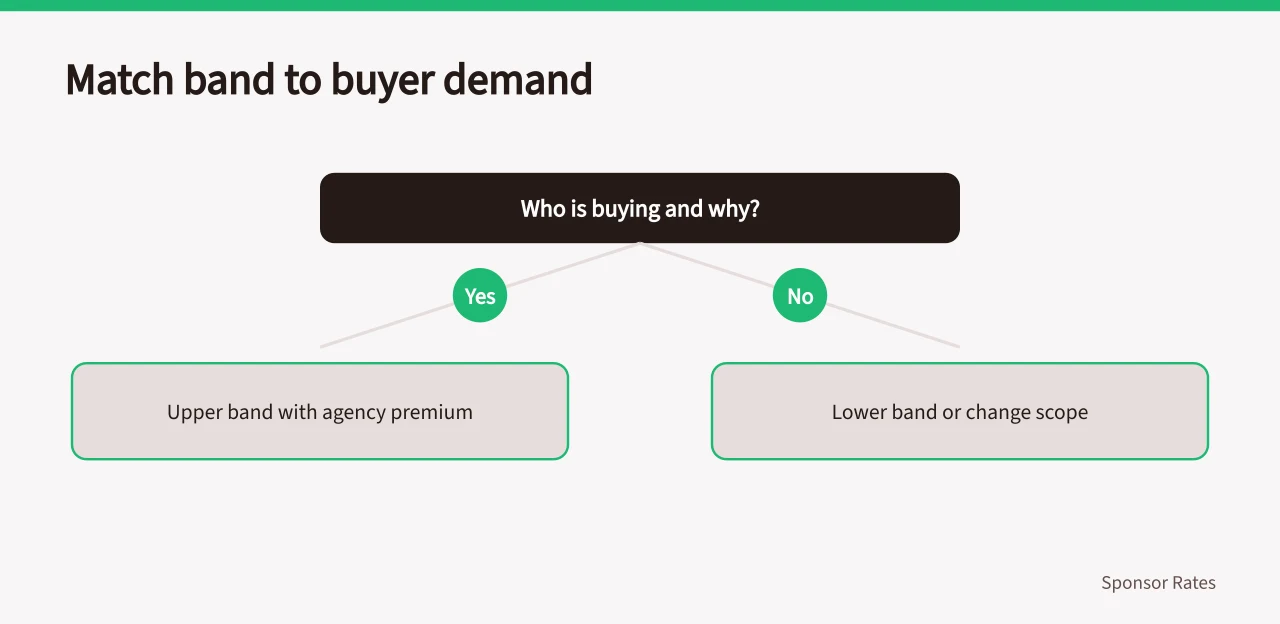
Matching price to local demand means reading the buyer, not just the city. A brand with a national budget buying in Leeds will pay more than a local retailer buying in the same city, so the band depends on who is buying and why.
Use four demand markers before you quote:
- Buyer typedirect brand, creative agency, media agency or public body.
- Budget cycle: always-on, campaign burst or annual retainer.
- Sector regulationFCA, ASA or CMA rules that add compliance work.
- Audience geographynational, regional or city-only delivery.
A direct brand with an always-on budget in Bristol sits at the upper band. A local retailer with a one-off campaign sits at the lower band.
A media agency in Leeds buying for a national brand sits at the upper band, and the brief usually bundles several formats. A Glasgow public body buying a fixed cultural campaign sits at the upper band with fixed deliverables.
The Insight Archive | IAB UK shows where UK digital advertising budgets by format and market are moving, which helps you argue for a band when a buyer pushes back. The ISBA | Knowledge Hub is useful when you are dealing with a planner who wants the rationale in writing.
When a buyer pushes back on price, ask which deliverable they can drop and requote that line. A quote that names each line, the usage window and the exclusivity term is easier to defend across three cities than a single headline number.
Comparing the three city rate cards side by side
A comparable city rate card format uses the same rows and columns for all three cities, so a buyer or an agency can read across. Keep the format identical and change only the band and the note.
Three city rate cards compared
Format
- Short-form video
- Mid
- Static post
- Low to mid
- Story set
- Low to mid
- Long-form review
- Mid
- Event appearance
- Mid to high
Bristol
- Short-form video
- Low to mid
- Static post
- Low
- Story set
- Low
- Long-form review
- Mid
- Event appearance
- Mid
Leeds
- Short-form video
- Low to mid
- Static post
- Low
- Story set
- Low to mid
- Long-form review
- Mid
- Event appearance
- Mid to high
Glasgow
- Short-form video
- Static post
- Story set
- Long-form review
- Event appearance
Comparing the three city rate cards
Bristol band
- Short-form video
- Mid (£600 to £1,200)
- Static post
- Low to mid (£250 to £700)
- Story set
- Low to mid (£200 to £550)
- Long-form review
- Mid (£700 to £1,400)
- Event appearance
- Mid to high (£800 to £2,000)
Leeds band
- Short-form video
- Low to mid (£450 to £950)
- Static post
- Low (£180 to £450)
- Story set
- Low (£150 to £400)
- Long-form review
- Mid (£600 to £1,200)
- Event appearance
- Mid (£650 to £1,500)
Glasgow band
- Short-form video
- Low to mid (£450 to £1,000)
- Static post
- Low (£180 to £450)
- Story set
- Low to mid (£200 to £500)
- Long-form review
- Mid (£600 to £1,250)
- Event appearance
- Mid to high (£700 to £1,800)
Figures: author's indicative estimates.
Read the table as a starting position, not a fixed price. Bristol leads on purpose-led and creative work, Leeds leads on agency volume and repeat campaigns, and Glasgow leads on cultural and public-sector appearances.
Keep one working card with all three cities and one city card per market. Agencies in Leeds and Bristol often ask for the wider regional picture, while Glasgow buyers usually want the Scottish figures only.
Review the card each quarter. Agency mix shifts, public budgets open and close, and sector demand moves with the advertising cycle. A card that is six months old will underprice your best work.